Blogger templates

Saturday, April 1, 2023 April 01, 2023

Title: Robert Bellah's Theory of Religious Evolution

I recently learned about Robert Bellah's theory of religious evolution, which posits that there are four stages of religious development: mimetic, mythical, ethical, and modernized. Bellah, an American sociologist interested in religious studies, argues that religion evolves in response to social and cultural changes.


The mimetic stage is the earliest stage, in which humans imitate the behavior of natural phenomena, animals, or plants that are considered sacred. For example, primitive societies that use a large tree as a totem or symbol of their beliefs.


The mythical stage is when humans begin to create stories or myths about things that are extraordinary or beyond reason. For example, the ancient Greeks who had many gods and goddesses that ruled over various aspects of nature and life.


The ethical stage is when humans begin to develop moral norms and laws based on specific religious teachings. For example, Jewish society that follows the laws of the Torah or Islamic society that follows the laws of Sharia.


The modernized stage is when religion becomes more rational, individualistic, and pluralistic. For example, Western societies that have religious freedom and tolerance for other religions.


I am interested in this theory because I feel that I can see the development of religion in Indonesia from this perspective. I am also curious about how religion will continue to evolve in the future. Will religion remain relevant or will it be sidelined by advances in science and technology? Will religion become more peaceful or will it become a source of conflict? Will I continue to hold onto my religion or will I seek out another religion? I feel that I need to learn more about this theory and other religions so that I can answer these questions.

Inspiring Story of Kiai Sholeh Darat: Strengthening the Rise of NKRI through a Different Approach

 Who says the struggle to achieve Indonesian independence can only be done through physical means? Kiai Sholeh Darat proved that resistance can be done through another equally great approach, namely by strengthening the spirit and faith of the community through a Sufi approach.


During the Dutch colonial era, the colonial regime had strong control over all sectors in the archipelago, making the people's mindset trapped and enslaved. However, Kiai Sholeh Darat did not stay silent, he raised the spirit of nationalism through religious and cultural approaches. Through his works based on the Pegon script, he successfully transformed Islamic values into local culture that was accepted by the wider community.


In the context of the physical revolution during the colonial era, Kiai Sholeh Darat focused more on preparing young generations of NKRI in the long run to create new orators to break the revolution led by the colonial regime. Later on, nationalist fighters who were prepared became the number one contributor to Indonesia's independence in 1945, including KH. Hasyim Asy'ari and KH. Ahmad Dahlan.


Through his approach and works, Kiai Sholeh Darat managed to cultivate the spirit of nationalism and increase the quality of the community's faith, without having to fight the colonial regime physically. In that era of limitations, Kiai Sholeh Darat achieved great success and made important contributions to Indonesia's independence. The inspiring story of this legendary kiai makes us realize that struggles can be done in many creative and unexpected ways.

Original Source: Strategi Kiai Sholeh Darat Melawan Rezim Kolonial (parrhesia.id)

Exploring Philosophy through "Sophie's World": A Review of Jostein Gaarder's Novel

 Dunia Sophie is a novel by Jostein Gaarder that discusses the development of ancient Greek philosophy. The novel was first published in 1991 in Norwegian with the title Sofie's Verden. Through his book, Jostein Gaarder provides a brief lesson on the history of philosophy with language that is interesting and easy to understand.


At one point in the novel, Sophie Amundsend, a 14-year-old girl, receives a mysterious letter from an unknown sender. She also receives strange letters addressed to Hilde Moller Knag. The letters contain messages from Hilde's father for her birthday. Sophie believes that the sender of the mysterious envelope, the questions inside it, and the letter to Hilde are all related.

Sophie's philosophy lessons continue as she receives a large brown envelope containing pages about the history of philosophy. The pages also contain some keywords for questions that Sophie has not been able to solve. The lessons continue until one day the sender of the letters, Alberto Knox, introduces himself to Sophie. He is an old man who lives in a shack behind Sophie's house with his beloved dog. Alberto has been sending letters to Sophie as a means of teaching her about the world beyond what she knows.

In addition to learning about the history of philosophy and its figures, Sophie also learns about Christianity, including the Old and New Testaments, the Semitic and Israelite peoples, and the Prophet Jesus (Isa) from a Christian perspective.

However, Sophie herself is a fictional character created by Hilde's father as a learning material for his daughter. This is revealed by another point of view in the novel, which shows that Sophie is a fictional character. The reality that she is a fictional character for Hilde is supported when Sophie tries to interact with Hilde but receives no response from her.

The philosophy lessons between Sophie and Alberto end with a big bang. Hilde has met her father, who works at the United Nations, and he tells her about the solar system. This can be referred to as the Big Bang theory or a cosmological theory. Her father also explains that there will be a big bang, which is in line with what God says in the Bible.

Overall, Jostein Gaarder's novel is very interesting to read and offers a valuable lesson on the history of philosophy.


Original Source: https://dimensipers.com/2023/02/07/sejarah-filsafat-dalam-baluran-fiksionalitas-dunia-sophie/

Why Political Participation Matters? Why Every Citizen Needs to Have a Say

 Voting for a candidate is important in an election, but political participation is more than that. Political participation refers to citizens' activities aimed at influencing political decisions. People participate in politics as citizens, not as politicians or government employees. Political participation is voluntary and not mobilized by the State or ruling parties.


Political participation is one of the essential aspects of democracy. The assumption underlying participation is that individuals know what is best for themselves. Because political decisions made and implemented by the government affect citizens' lives, people have the right to participate in determining political decisions.


Citizens' political activities are divided into two categories, influencing public policy and participating in decision-making and policy implementation. In general, the typology of political participation as activities is distinguished as follows. First, active participation is orientated to input and output processes. It means every citizen is actively proposing suggestions regarding public policy, submitting alternative public policies different from government policies, providing criticism and improvement to straighten out general policies, voting for government leaders, and so forth.


Second, passive participation is only oriented to output, in the sense of only complying with government regulations, receiving and carrying out every government decision. Third, the white group (abstention) or the apathetic group considering that the existing political system has deviated from the ideals.


Citizens' political participation activities have a significant impact on the political system and the survival of a country, especially in achieving its goals. Good political participation is participation that grows from awareness as pure participation, without coercion.


In a totalitarian state, political participation is polarized according to the policy of the ruling elite (government elite, party elite). Such participation tends to be mobilized for ideological purposes such as Marxism or communism.


Achieving pure participation demonstrates that the communication ties between infrastructure elites (ruling elites) and harmonious ties. To realize pure participation, society must be complete and receive enough communication and information about government policy steps related to the interests of the community.


Political consciousness of citizens becoming a determinant factor in people's political participation, meaning that various things related to knowledge and awareness of rights and obligations related to the social environment and political activities are a measure and degree of someone's involvement in the political participation process.


Original Source: https://dimensipers.com/2023/01/06/pentingkah-partisipasi-politik/

The Tale of Sahadewa and Sakula: The Bond between Twins

 We all know how strong the bond between twins can be, just like in the tale of "Sudhamala." After Sahadewa's departure, Sakula went in search of him and found him in the village on the outskirts of the Prangalas forest. All of this is thanks to the guidance of Dewi Uma (Parwati).


At first, Bhagawan Tambrapetra wanted to marry his twin daughters, Ni Soka and Ni Padapa, to Sahadewa. However, Sahadewa only wanted to marry Ni Soka because he missed his twin brother, Sakula. He suggested that Ni Padapa be married to Sakula. This shows how strong the bond between twins can be. They are willing to share, not compete.


Suddenly, Sakula, who was sent to find Sahadewa, also felt the same longing for his brother. So, Sakula was married to Ni Padapa. Therefore, both families finally met. Dewi Kunti, along with Yudhistira, Bhima, Arjuna, and two Punakawan, came to meet them in Prangalas.


After reuniting, the Pandawa family said goodbye to Tambrapetra, Ni Soka, and Ni Padapa. They had to return to their country, Amartha, because an important task was waiting for them: they had to enter into battle against the Kurawa side, who were assisted by two powerful giants, Kalantaka and Kalanjaya.


The story teaches us how strong the bond between twins can be. It's truly beautiful to see!

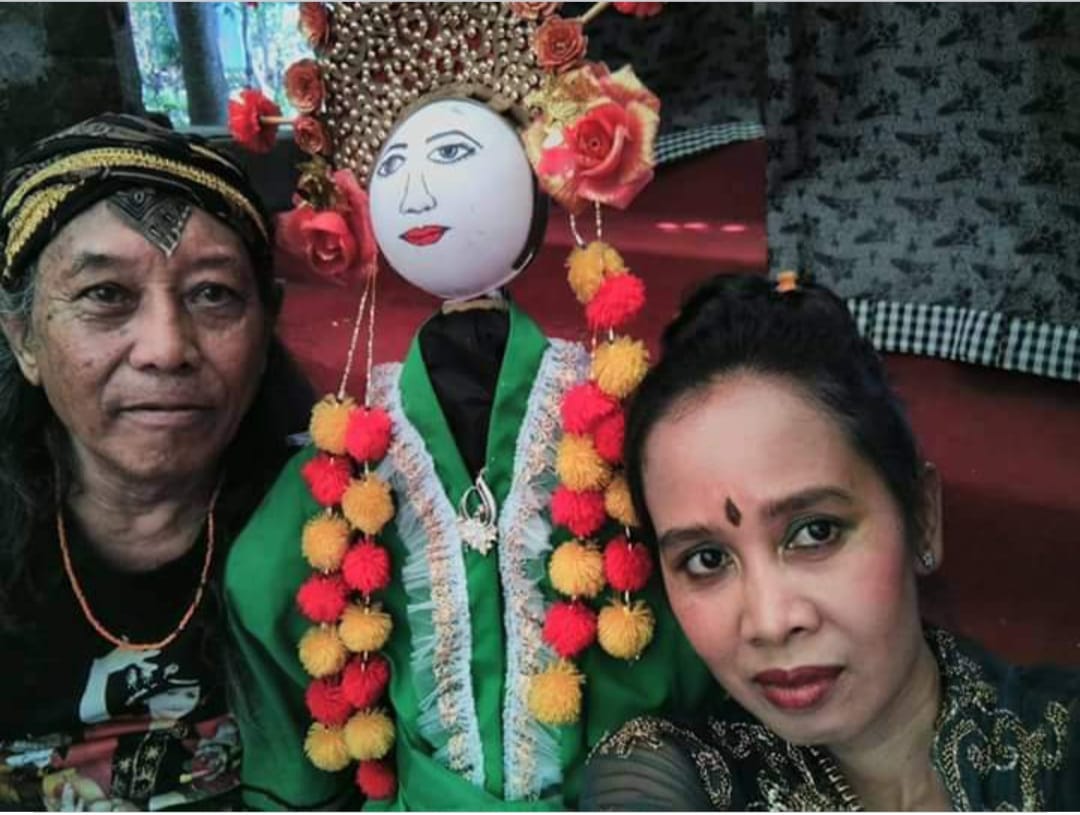
Remembering Mbah Yongki, The Culture Bearer of Malang Raya

 Last night I didn't expect to meet a group of artists and cultural figures at John Cafe, Jl. Majapahit. They gathered to celebrate Prof. Joko Saryono's birthday. However, in the middle of the event, something unexpected happened. Mbah Yongki Irawan, who was sitting on the terrace with his fellow colleagues suddenly passed out.


We all panicked and immediately tried to provide assistance. We contacted the "volunteer health ambulance" to take him to the hospital. Unfortunately, Hermina hospital was full of patients, so we had to take him to the ICU at Saifull Anwar Hospital.

There was a moment when he seemed to be getting better, but then another attack occurred. Sadly, after optimal medical treatment, precisely at 00:32 on Tuesday morning, March 28, 2023, Mbah Yongki Irawan took his last breath at Saifull Anwar Hospital. His fellow cultural activist friends stayed with him until the end.


Myself and the other art and cultural friends who gathered that night were still overwhelmed with sadness after feeling joyous celebrating Prof. Joko's birthday. We came together to pay our final respects to this extraordinary cultural figure. I was reminded of the speech I gave at the Dolanan Village Festival on the street in front of his house six years ago about "Nyi Putut", which was actually a representation of Mbah Yongki's identity in the last decade of his life.


May his soul be accepted by the Almighty and always inspire us all with his monumental works. Farewell, Mbah Yongki "Putut" Irawan, the culture bearer of Malang Raya who has left behind many works and inspirations. Padhang dalane and jembar kubure. Amin.


NYI PUTUT, DOLINAN BOCAH

     Oleh: M. Dwi Cahyono

     Siapakah engkau wahai Nyi Putut?

     Kenalkan, akulah istri Jelangkung.

     Ada juga yang menyebutmu "Nini Diwut".

     Mainan lawas, yang kian dilupakan orang.

     Ayo, ayo, undang aku jika ada pesta,

     Dendang riang pestamya anak desa,

     di kala benderang candra purnama.

     Aku sahabat anak-anak.

     Teman mainmu bersama.

     Gerakku, goyangku, tarianku

     bukanlah rasukkan "roh halus",

     melainkan konsentrasi fikirmu,

     berkat topangan gerak tanganmu,

     dalam suatu irama kebersamaan.

     Jaganlah takut kawan denganku.

     Aku toh sobatmu, teman mainmu.

     Tak ada roh halus dalam wadagku.

     Aku hanya rakitan peralatan dapur,

     yang dibuat sebagai wahana bermain. 

     Bersama dengan Mbah Yongki,

     mari kita pestakan permainan ini.

     "Rasakan geraknya.

     Ikuti goyangannya.

     Indahkan tariannya.

     Namun, senantiasalah

     di dalam kesadaranmu".

     Begitu Mbah Yongki memandu.

     Nyi Putut pun memulakan unjuk gerak.

    Tempurung kelapa yang jadi kepalanya

     bergeleng kanan~kiri, muka-belakang.

     Kukusan berbusana yang jadi tubuhnya

     tergoyang oleh ayunan tangan pemain.

     Dengan mata terpejam, empat pemain

     bergerak menarikan Nyi Putut di arena.

     Khalayak penonton tertarik mendekat.

     meski pula kadang semburat menjauh, 

     lantaran timbul rasa setengah takut.

     Hem ............., ‘ngeri-ngeri sedap’.

     Kelompok demi kelompok gantian

           memainkannya.

     Bukan hanya anak, yang dewasa pun

           beringin main.

     Justru di tangan pemain dewasa, 

     gerak Nyi Putut semakin beringas.

     Tubuhnya bergoyang, kian kencang. 

     Bergerak sigrak, bahkan minta lompat.

     Pemain mulai kuwalahan layani

          keinginan Nyi.

     Meski bercucur keringat, namun tetap

          bersemangat.

     Mbah Yongki beri komando turunkan

          dinamika.

     Gerak Nyi Putut berangsur melemah, 

     hingga pada akhirnya terdiam, mematung.

     Perlahan pemain diminta membuka mata,

     dan dikembalikan pada kesadarannya.

     Diantara para pemain mulai berguman.

     Paparkan pengalaman mainkan Nyi Putut.

     Pengalaman langka, baru sekali dialami.

     Ternyata, bukan menakutkan, 

     sama sekali tidak mengerikan,

     malahan demikian menyenangkan.

     Oleh karena, hanya sekedar permainan.  

     Nyi Putut, Nini Diwut atau Jelangkaung

     adalah mainan tinggalan nenek moyang.

     Bukan barang luar produk mainan asing, 

     meski kini diposisikan jadi mainan usang.

     Oleh karenanya, lestarikan, faedahkan.

     Nuwun.

Malang, 28 Desember 2017

PATEMBAYAN CITRALEKHA

Committee, Cigarettes, and Humanity

 So I just responded to the procurement of cigarettes for a committee, and it turns out that my response elicited different reactions. Some were confused if I was wrong, some also responded that the procurement of cigarettes was common. So, before I reveal my response, I remember that this article is not just about cigarettes and perhaps it is bigger than that. That is why reading this article is important for you to do thoroughly.


This article is about the environment, specifically in the academic environment among students in a faculty. There, I almost always find a cigarette party specifically for the committee for every event that I attend. Administratively, the general view states that cigarettes cannot be listed freely in the budget or reporting of an activity. So, how can the committee get cigarettes? You must know that cigarettes are a "common" type of consumption. Sometimes, food and drinks are also treated like cigarettes and must be fulfilled in certain conditions.


Regarding consumption, especially food and drinks, the committee gets it equally or without special distribution, except sometimes there is a distinction between the committee and participants of the event. The focus is that every committee gets the same consumption share. Sometimes the type of consumption is determined democratically by the entire committee. We may consider that democratic deliberation and equal consumption share are a manifestation of togetherness, transparency and solidarity.


"Isn't logic collapse if humans are without logistics?"


Is smoking also a result of togetherness and solidarity of the committee? I see that often it is not. It is not my intention to say that smoking is a purely negative manifestation of that question. But as in the narrative above, the budget for cigarettes is "common". Its presence in certain conditions is a collective awareness and can be summoned by saying, "ehm ... the cigarette." The treasurer or chairman will do a little touch to procure it. Because it is so common, I often find that non-smokers are not asked what "cigarettes" they want and it is expressed as "which kind of cigarette".


Is humanity related to "this cigarette"? In this article, I assume it is. I think that it could be very easy to abandon humanity with alternative "common" behavior, and that is "common". Maybe, after reading this article, some people still believe that non-smokers are "common" not to get their "cigarettes"? Definitely don't.


Apart from the influence of "common" behavior alternatives as mentioned above, the idea of "non-smoker cigarette" still seems vulnerable to collapse. Like when non-smokers say, "It's okay (no problem with cigarette budgeting without considering non-smokers)." I might say it for the reason that the non-smoker cigarette version is something trivial to ask for. Remember, if so, why can smokers easily request their cigarettes, which for others, the non-smoker's cigarettes, are considered trivial? I think this is again about commonality, adding to the collective view that does not support equal voices in determining their respective "cigarettes".


If our group wants to change this biased "commonality," we can make it a shared understanding and spirit. We also need to be aware that mandate holders, such as the head of the organizing committee or influential people in the committee, need to be actively involved in fulfilling the rights of each committee member. We need to do more than "common". Because if not, neglect will easily infect any group, including a student committee, not only about cigarettes but also other "common" things that may be more vital.

Original Source: https://lpmaksara.home.blog/2021/04/26/rokoknya-nonperokok-dan-kesetaraan-konsumsi/

Blogroll

Powered by Blogger.

Contact Form

Name

Email *

Message *

Search This Blog

Top Stories

Pages

Blogger templates